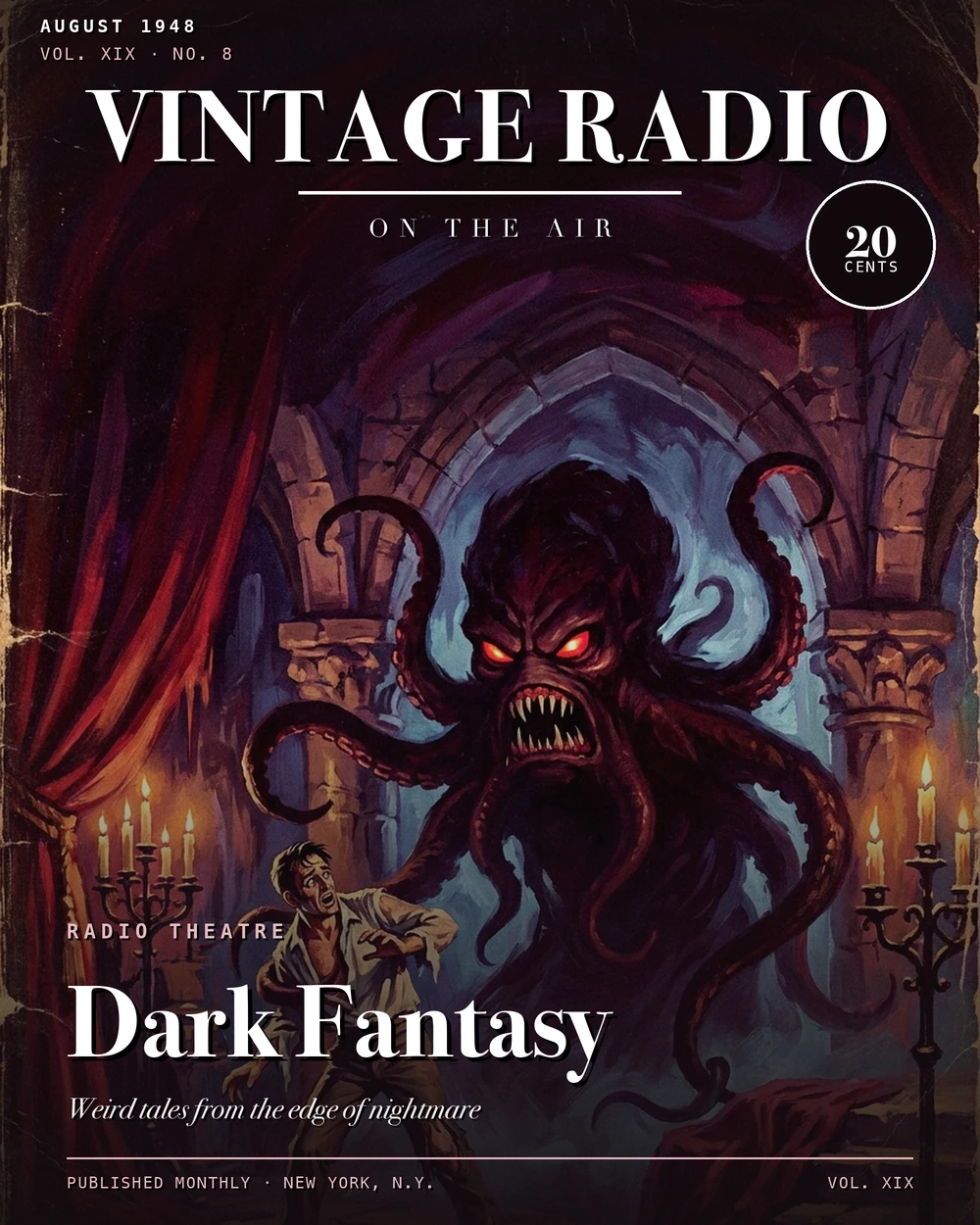
Dark Fantasy
Where It Came From
Dark Fantasy holds an unusual place in old-time radio history: it was, by most accounts, the first dramatic series originated from a station outside New York, Hollywood, and Chicago to air on the national NBC network. That station was WKY in Oklahoma City, and the show it sent out to more than 125 NBC affiliates was a weekly half-hour of horror, suspense, and supernatural storytelling that debuted on November 14, 1941.
The origin story has a fittingly late-night quality to it. According to an account on radiohorrorhosts.com, the show was conceived on the night of November 3, 1941, when writer Scott Bishop and radio production man John Prosser sat down together and talked through what it might look like. Bishop went off and wrote the first script, "The Man Who Came Back," and within weeks the series was on the air locally at WKY. After roughly eight weeks of local broadcasts, NBC picked it up for national distribution. The show aired on Friday nights around 11:30 p.m. — a timeslot that suited the genre well enough, even if it meant a smaller audience than prime time would have offered.
What makes the WKY origin notable isn't just the geography. The series was written, produced, and largely acted by WKY staff, an unusual arrangement in an era when dramatic radio almost always flowed from the major production centers. The fact that a regional station in Oklahoma could put together a horror anthology polished enough for a national network chain says something about the ambitions of the people behind it.
The Man Behind the Scripts
Scott Bishop wrote the scripts for Dark Fantasy — all 31 of them across the original NBC run. The name turns out to be a pseudonym. Research has identified the real writer as George M. Hamaker, continuity chief at WKY, and the SFE Encyclopedia gives his full name as George Marion Hamaker, with birth year 1912 and a death year tentatively placed around 1996. A Tangent Online commenter with apparent research background corroborates the pseudonym identification independently.
Some popular old-time radio sources have also credited Bishop/Hamaker with writing for other horror anthologies of the period, but that claim is on shaky ground. The Tangent Online researcher argues there is "absolutely no proof" that Hamaker wrote for those other series, and the SFE Encyclopedia is careful not to assert it. The association appears to have been repeated across OTR reference sites without solid documentation to back it up. Richard Breen is also credited as a writer on the series, so Hamaker wasn't the only hand at work on the scripts.
The production was handled by John Prosser — credited variously in different sources as John I. Prosser and John J. Prosser — also of WKY. The announcer's chair was filled by Keith Paynton (sometimes spelled Painton), with Tom Paxton listed as a later or alternate announcer in researcher documentation. Recurring actors Ben Morris and Eugene Francis took on new roles week after week, the way radio performers did when there was no standing cast of characters to return to.
What the Show Sounded Like
Dark Fantasy ran about 30 minutes per episode and leaned into the horror and supernatural end of the dramatic spectrum. The titles alone give a sense of the range: "The Thing from the Darkness," "The Lodger," "The Horla," "Beyond Good and Evil," "Three O'Clock," "Edge of the Shadow." Some episodes paired two shorter stories — "Homecoming & Aunt Cassie," "The Bet & Clerk's Quest," "Evening & Strange Orchid" — suggesting the scripts sometimes ran short enough to need a companion piece.
Bishop's stated philosophy about writing for the ear was direct and practical. "Give the listener enough material to let his imagination go to work, and he'll supply his own goose-pimples," he said. Lean on suggestion rather than explicit description, trust the audience to fill in what you leave out. That approach was well suited to radio, where the picture only exists in the listener's head anyway, and it held up well enough that Variety described Dark Fantasy as "vividly atmospheric."
The show's publicity made an explicit comparison to NBC's then-dormant Lights Out, positioning Dark Fantasy as something of a successor to that franchise. Whether the comparison was warranted in terms of sheer intensity is a matter of taste, but it signals how the show wanted to be understood: as serious horror drama, not comedy or adventure with a spooky backdrop.
The NBC Run and What Came After
The original network run was short. Dark Fantasy debuted on November 14, 1941, and NBC cancelled it in early summer 1942, with the final episode airing on June 19, 1942 — 31 episodes in total. That's a tight window, and it ended without much fanfare. The Oklahoman newspaper was still noting the show's 31-episode run as late as April 1944, suggesting it left enough of an impression in its home state to be worth remembering even two years on.
The episode record extends to a latest known broadcast date of April 24, 1957, which is considerably after the 1942 NBC finale. That date likely reflects a later rebroadcast or syndication run rather than original production; no available source documents a second production cycle or a revival on any network. What the 1957 date does suggest is that the material was considered worth airing again more than a decade later, which isn't nothing.
After Dark Fantasy, Hamaker created a follow-up series for local Oklahoma City audiences: Tales of the Witch-Queen, which ran in 1944 for nine 75-minute segments. Only two episodes survive. It's a reminder of how much regional radio production existed during the golden age that never made it to the national networks and has largely disappeared.
How It's Been Studied
Dark Fantasy has attracted more scholarly attention than its brief network run might suggest. A peer-reviewed article in the Journal of Radio & Audio Media (Vol. 20, No. 1) examined the show as a case study in the golden age radio mystery-thriller genre, arguing that it illustrated the broad generic diversity of the form — that "horror" was a wider and more varied category than it might appear from a distance. The series also has a dedicated published listener's guide, "Old-Time Radio Listener's Guide to Dark Fantasy" (OTR Listener's Guides #2), which covers each episode with synopses, cast lists, and commentary. And the show had a promotional tie-in with Movie Radio Guide, which printed episode stories alongside illustrations — an early example of cross-media content that helped build an audience for a late-night network offering.
Thirty-one episodes, a Friday night late slot, a pseudonymous writer working out of an Oklahoma City radio station — Dark Fantasy was never going to dominate the ratings. But it got to the national network on its own terms, sounded good enough that Variety took notice, and left behind enough material for researchers to still be writing about it decades later.